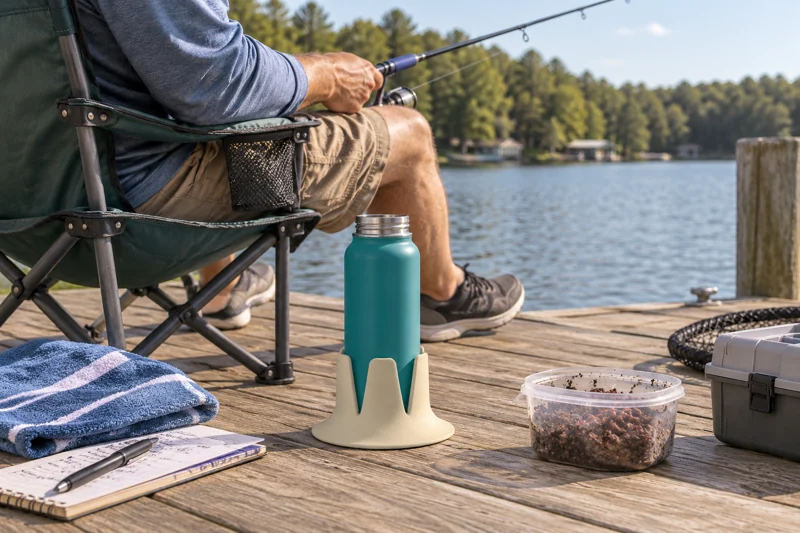
Finally, somewhere to put your drink on the dock.
122 reviews · 4.9 average · 98 verified purchases
Steadi Labs LLC — Scott Rodriguez, founder. Veteran founded.
3419 E Chapman Ave #411, Orange, California · hello@steadilabs.com
“First time I have ever ordered from Facebook feed. Very easy. Happy with product.”Steve Butler · 8 August 2026
A flexible-finned base that holds your can, seltzer, or 40 oz tumbler steady on the boards, the chair arm, or the dock box lid — wherever you've actually set up. Nothing drills in, nothing clamps on; it moves with you.
Get one for the dock — from $14.95Free shipping · 90 days on your own dock to prove it · Made in Orange, California
Will it fit before the wake gets here? A sticky note answers it — the test is below ↓

The current arrangement
A dock is built to drain, not to hold your drink.
Every drink that comes down the hill to the dock has to land somewhere — and none of the usual spots were ever built to hold it still.
A standard dock section runs boards gapped an eighth to a quarter inch apart for drainage, and weathered wood cups, crowns, and warps as it ages — often on a deck already pitched slightly toward the water. Nothing about that geometry was built to hold a can upright.
Even inside a posted no-wake zone — roughly 5 mph within a couple hundred feet of the dock on most lakes — boat traffic keeps arriving all weekend, and a floating dock answers every pass with a slow roll. It moves under your own footsteps too.
A tipped drink on a dock doesn't leave a stain to blot up — it rolls through a gap or off the edge and it's simply gone, into the lake. It's a real part of why glass gets left up at the house before anyone heads down to swim or fish.
Dock hardware fixes a drink to one drilled spot, one post, or one rail at the perimeter — while the chairs, the towels, and the people actually move around the deck all day. The holder's loyal to the dock. Nobody else out there is.
A lake-day can sweats hard in the sun, and what it sheds lands right on the boards underneath it — enough to make a smooth composite or aluminum deck slick before the can ever gets a chance to tip on its own.
None of it wrecks the afternoon. It's a placement problem you keep re-solving, once per trip up the ladder with a drink in hand — and you'd stopped noticing you were solving it.
You've been here
This has already happened on your dock.
A wakeboat runs past outside the no-wake buoys, and half a minute later its wake reaches the floating dock in sets. The deck rolls twice, everyone's hand goes to a chair arm, and the seltzer standing by the cooler goes over on the second wave.
Sitting on the bullnose with your legs in the lake, can set on the boards behind your hip. One kid cannonballs off the end, another's dripping up the swim ladder — you twist to keep an elbow clear of both and put it straight into the can instead.
Casting off the end of the dock with the drink parked at your feet on a cupped board. A fish actually hits, you step back fast to set the hook, and your heel lands exactly where the can was.
Both hands full — cooler in one, bow line off the cleat in the other — so the coffee gets parked 'for a second' on the sloped dock box lid. The boat nudges the dock as someone steps aboard, and the lid sheds the cup the way it sheds rain.
The dock's back in the water and the chairs came down the hill, but the side table never makes that trip. The first cold drink of the season goes straight onto bare, gapped boards, because there's never been anywhere else for it.
The fit test
A fit test faster than the wake gets here.
lands in here
A square sticky note: exactly 3 inches — no ruler needed at the dock box.
The classic square sticky note measures exactly 3 inches on a side — a fact about sticky notes, and it happens to land right at the ceiling of what the base holds.
Test it the way it actually comes off the ice: a slim seltzer runs about 2.25 inches across and a standard can about 2.6 — narrow enough that a wet ring on the sticky note is the whole test, no ruler required.
Base sits inside the square? It fits. Hangs over the edge? Too wide. A tiny puck lost in the middle — under 2 inches? Too narrow to hold steady.
No tape measure at the dock box, no guessing with a cold can already sweating in your hand — one sticky note, on the counter, before the cooler goes down the hill.
Fit verdicts
The bottom inch decides what rides the crown.
One line covers the whole dock: a container base 2 to 3 inches across settles in. Every verdict below follows from it.
- Standard 12 oz can fits
- Slim seltzer can fits
- 40 oz Stanley-style tumbler fits
- 20-30 oz stainless tumbler fits
- Koozied can fits
- Glass bottle usually left at the house
- Kids' water bottle fits
- Travel mug, handled handle in the way
There's a floor as well as a ceiling — under 2 inches the base sits too loose on a moving dock. The handled travel mug is the honest exception: the base is in range, but the handle sits exactly where a fin needs to grip.
The full fit database — Stanley, Red Bull, Yeti, and 30 more, with sourced base measurements →
The case for it
Three reasons it stays put on the dock.
Rides the crown instead of balancing on it
Weathered boards cup and crown, and a dock box lid domes to shed rain — nothing up there gives a narrow base a flat landing. The wide, low base spans the curve instead of teetering on the high point, so it doesn't need a flat spot that doesn't exist.
Goes wherever you actually are
It isn't drilled to one spot on the rail or bolted to a piling — it moves with you from the cooler to the bullnose to the chair arm, one hand, in a second. Wherever the day is happening on the dock, the base goes there too.
Built for what actually comes down the hill
The sweating can, the slim seltzer, the 40 oz tumbler with a straw — it holds steady through condensation, a wet composite deck, and a rolling float, then rinses clean and stows flat in the dock box when the day's done.
Function
Built for boards that never sit flat.
Pressure-treated boards cup, crown, and pitch as they weather, and a dock box lid domes to shed rain — nothing out here is actually flat. The wide, low base rides across that curve instead of perching on one high point.
Flexible fins hold the can or tumbler by its bottom inch, so a rolling wake or a footstep on a floating dock can't rattle it loose.
A wake reaches the float, a kid cannonballs off the end, someone drops into the chair beside it — the wide base keeps its weight low, so it rocks instead of tipping, and brings the drink back level.
The physics of the dock
The lake reaches every one of these six spots.
Drinks don't go over on a dock because someone's careless — every surface out here is built to drain, flex, or shed water, not to hold a cup still.
Boards go down with a deliberate eighth-to-quarter-inch gap for drainage, and older ones cup, crown, and warp as they weather — often on a deck already pitched toward the water. A can standing on the crown rocks toward the nearest gap or the edge, and there's no floor out here to catch what tips.
Dense, smooth boards that soak up sun — a dark composite surface can run roughly 140 to 170°F on a 90° day — and carry a slick film the moment a sweating can starts to wet them. The can slides before it ever gets the chance to tip.
Buoyant sections built to move — manufacturers describe good floating-dock stability as controlled movement, not stillness — so whatever's standing on it rolls a few seconds behind every wake that reaches the dock, and the narrower the run, the more the edges move.
Flat but narrow, and often sloped, sitting right at elbow height — the first place anyone sets a drink down, and the first thing an elbow or a stand-up motion catches on the way past.
Molded or crowned to shed rain instead of sitting flat, and built to open on demand — a drink parked there slides on the slope, and it's in the way the second anyone needs what's inside.
The board closest to the lake, where people actually sit — feet already in the water, drink set down at the hip. A splash, a wake, or one bumped knee, and it's gone, with no second chance to grab it.
Why drinks go over on a dock — and what actually keeps one upright — the full story →
Other routes
What's already screwed, clamped, or drifting out there.
| A screw-down dock cup holder | The Dock Cup Holder | |
|---|---|---|
| Standing on a cupped or crowned board | Needs a flat, level spot to mount | Rides the crown, settles in anyway |
| Where it lives on the dock | Fixed at the rail, wherever it's drilled | Cooler to bullnose to chair arm, same base |
| Setting it up | Pilot holes drilled into the decking | Sets down - no tools, no holes |
| Once it's actually mounted | Bolted through the board - doesn't budge from that spot | Resists tipping, but a hard kick can still move it |
| Takes the 40 oz Stanley tumbler | Sized for a can - the big tumbler doesn't fit | Fits, base settles in same as a can |
| When the dock comes out | Screwed in - leaves only if the dock does | Already loose - goes in the bin with the chairs |
| Cost | Another purchase to install, one spot for good | One small piece, worth it at every spot you sit |
They need pilot holes drilled into good decking and a level, flat spot to mount to — and once they're in, they're in one place for good, on a dock some owners pull out of the water every fall.
They only work where there happens to be a post the right size, so the drink lives wherever the piling is instead of wherever the chair is — and the cup insert itself is usually sold as a separate add-on.
They need a dock frame or an accessory rail built to accept them; a plain wood dock has nothing to clamp onto, and even where one fits, the holder sits at the rail, not next to the chair.
Owners' recurring complaint: without a tether they drift off on their own, a tall cup or a wine glass tips over in any real chop, and getting one back means wading or swimming after it.
From the reviews
What buyers say.
Recent reviews of the Steadi, from every room and rig it lives in.
I have a tendency to spill my drinks and have two cats. This is one of the best things I’ve ever impulse bought. It works. It actually works. It’s a heavy, wide enough base that it is actually stable. My “spot” in the living room is near a somewhat-cushioned fabric ottoman, which is where I usually put my drinks. It’s
Dixie · 2026-08-30Excellent!
Brian S. · 2026-08-27It’s great love it
gilbert a. · 2026-08-24I never knock over my water at night anymore!
Steadi customer · 2026-08-2198 of the 122 published reviews are for the drink base itself. The other 24 are about ordering, shipping and customer service.
Why more than one
Two identical tumblers. No telling whose is whose.
Everybody on the dock seems to own the same 40 oz tumbler these days, and two of them end up sweating side by side on the cooler lid by mid-afternoon. After the second wake rolls through and both get picked up and set back down, there's no telling whose is whose anymore — same size, same lid, same ring of condensation.
Build your set
Give everyone their own.
Pick a pack, then give each one a color — so nobody has to ask which drink is theirs.
Straight answers
Asked dockside, answered here.
Does it actually hold up on weathered dock boards?
That's the whole design brief. Cupped, crowned boards give a narrow base nothing to stand on; the wide, low footprint rides across the curve instead of perching on the high point, and the fins keep the can from rattling loose when a wake rolls through. Bump it off level and it settles back.
My dock floats — doesn't everything just slide off out there?
Floating docks are built to move — even the manufacturers call good stability 'controlled movement,' not stillness. This resists tipping and lets the drink settle back down as the float rocks. It's not a sealed lid, so pair it with a lidded tumbler if you want both layers on a busy wake day.
Will my can or tumbler fit?
Measure the bottom, not the rim. A base 2 to 3 inches across fits — the 40 oz Stanley does. Handled mugs don't; the handle lands right where a fin needs to grip.
Does it drill, clamp, or mount to anything?
No. Nothing gets drilled into the decking, clamped to a rail, or mounted to a post. It sits on top of wood, composite, or aluminum, and it picks up in a second — whether that's a walk to the chair or dock-out in the fall.
What actually happens if it goes in the lake?
It doesn't float — over the edge, it sinks like anything else that isn't built to. Soaking it on purpose is a different story: rinse off a summer of sunscreen and lake water and it's completely fine.
Does it work on the chair arm and the dock box, not just the boards?
Yes — it works at least as well on a hard, flat surface. The wide footprint and the grip keep a bumped drink from sliding off a chair arm or a crowned dock box lid, which is worth having even where the boards aren't the problem.
Boat traffic keeps my dock moving all day. Does that end it?
Movement is the whole design brief. Its low, wide weight rocks with the float or the boards and lets the drink settle back down after a wake passes. It resists tipping — it's not magic, so a direct hard kick off the edge is still a direct hard kick — but a passing wake is exactly what it's built to shrug off.
How do I clean it after a day of sunscreen and lake spray?
Rinse it, wipe it down, or put it in the dishwasher. It's one piece of flexible material with nothing to come apart or trap water inside.
Who makes it, and where do I buy one?
It's called the Steadi, molded in small runs in Orange, California by Steadi Labs — veteran-founded and patent pending. Every order ships free from steadilabs.com, with 90 days to change your mind.
Made by
Not off a dock-hardware rack — molded in Orange, California.
The maker is Steadi Labs, a small veteran-founded company in Orange, California. It's injection molded in small runs, and nothing about it comes from a dock-hardware catalog — the mold, the material, and the color runs all sit within about three and a half miles of the shop. The people who make it read hello@steadilabs.com themselves, usually before the first boat's even off the trailer.
Ninety days on your own dock.
Run it for a month — on the boards, the chair arm, the dock box lid, wherever the day actually happens. If it doesn't do what this page says, email hello@steadilabs.com and it gets made right. No forms, no fight.
Veteran-founded · Patent pending · Made in Orange, California
Keep the drink on the dock, not in the lake.
The can stands next to you — on the boards, the chair arm, or the bullnose — through every wake that rolls in, while your fishing line makes the only intentional trip over the edge all day.
Grab one before the next wake — ships freeCheckout happens at steadilabs.com — Steadi Labs is the company that makes it.